How Much Are We Allowed to Want From Our One Wild Life?

Dear Community,
It is a fascinating and humbling process, this sitting down to write my Monday morning newsletter, especially when I have no idea what I actually want to say. It is an exercise in surrender and deep listening. There are things that clearly want to be expressed, and then it's easy, and sometimes there is a deep empty space. That is where I start going through the notes I made the weeks prior, in an attempt to solve this very problem. Being prepared is one of my favorite states (not that I do a good job with it, but at least I try).
This morning, I am feeling sad and somewhat uninspired, so this will be a newsletter composed of random thoughts, that I had over the summer, different ideas that crossed my mind, ideas that I read and borrowed.
I will start by posting the answers to the Persephone newsletter.
Sanda said: "I understand your feelings. I think a perfect place for us like emigrants doesn’t exist anymore."
Sanda, I think you may be right. Maybe the perfect place for us emigrants doesn’t exist anymore, because we ourselves have changed. We carry pieces of several worlds with us, and no single place can quite contain all of them. Maybe that’s part of what Persephone is teaching me: that after crossing between worlds, “home” can no longer mean simply returning to one place. I have to create a home that can hold the contradictions, the losses, the loves, and the parts of ourselves that were born in different places.
I’m still figuring out what that looks like.
Emma said: "Some responses I have:
1) as someone who grew up in a family where everyone was accepted but me, I’d have to say belonging is something created but is expected to be inherited. It’s devastating when it is not inherited but when created and accepted belonging is just that much sweeter.
5) I think home is where you feel emotionally safe, and I think home is a more flexible term than we allow it to be.
Happy napping!"
Emma, I love this distinction between inherited belonging and created belonging. There’s something so painful about discovering that the belonging we were supposed to inherit simply isn’t there, and yet something incredibly powerful about realizing that belonging can be created rather than merely received.
And I really resonate with what you said about home being emotional safety. Maybe that’s why “home” has become such a slippery word for me. I’ve been looking for it in geography, when perhaps some of it has to do with the people, relationships, and inner landscape in which I can actually exhale and relax.
After all, it looks like home is less a place we find and more a place we learn to create.
Happy napping to you too.
Sherri said: "I always flag these newsletters to reply bc I love them so much. But then I never find anything to say, so I move on without replying. This time is no different, nothing insightful to say - except one thing specific - I LOVE that photo SO MUCH!! You can feel and hear the laughter through the screen. Thank you for these, I love them & ready every word of every one!"
Sherri, this made me laugh. I know exactly what you mean about mentally flagging something to reply to and then watching the moment disappear into the ethers.
And honestly, “I LOVE that photo SO MUCH” is a perfectly wonderful response. That photo makes me happy too! There was so much completely unselfconscious laughter happening in that moment, and I love that somehow it traveled through the screen to you. Thank you for reading every word and for telling me. It means more than you probably realize. And now I’m very glad you finally broke your “I should reply” curse.
Thank you again, Dear Readers, for reading, and for sharing of yourself with me in this virtual space.
I have been asked several times recently, while I was in Romania, what my newsletter is about. My answer has been: whatever is alive for me in the moment and that is true, but there is a deeper reason why I write it.
Why do I keep making this commitment to sit down for a few hours every Monday morning, rain or shine, and share my thoughts, my voice, my inner landscape with whoever is on the other side of the screen?
Almost a year ago, my Dream and Business Teacher said something that I will always remember. He was talking about the forces shaping the world, and about those of us who can see the destruction of this beautiful planet and want something different: a more peaceful, sustainable, regenerative, less extractive world for our children and for everyone else's children. His point was simple and, to me, profound: The people who want peace need to become as organized, as visible, and as effective as the people who want war. We cannot assume that because our intentions are good, the world will somehow know about them. I haven't learned how to organize in the way he was talking about, I am still figuring it out. But! I am learning to use my voice, to speak what I see, to say what I believe, to put my presence into the world rather than keeping it safely contained inside my own life, and this newsletter is one small practice of that.
It is also terrifying. I always think: I don't want to hurt anyone's feelings. However, underneath that is something more frightening.
What happens when I tell the truth?
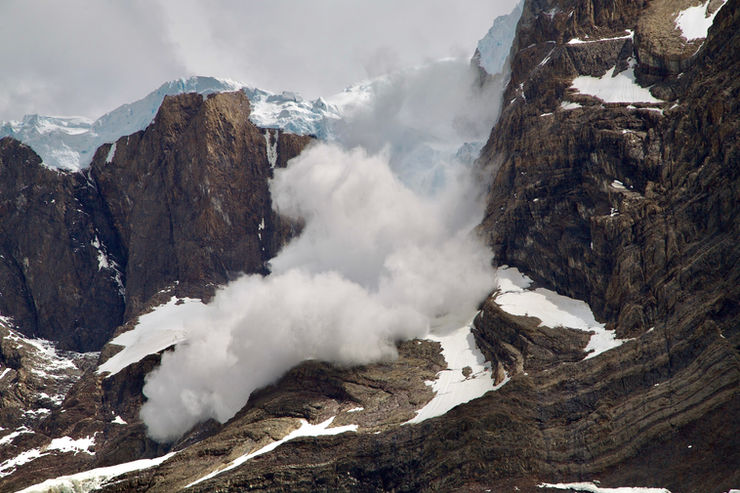
Telling the truth has consequences that we cannot fully see, It is a little like shouting in a winter mountain range covered in snow. You make one sound, and somewhere far beyond your field of vision, something may begin to move (a bit like starting an avalanche). You don't know whether what you have set in motion will be small or enormous, whether it will touch one person or many. You speak, and then you have to live with the fact that you cannot control what happens next.
There is also something about telling the truth that feels like throwing yourself into an abyss. You let go of the familiar protections, the careful editing, the desire to be understood by everyone, the hope that you can somehow make yourself inoffensive. And then, you discover whether there is something there to catch you.
Terence McKenna described this beautifully: "Nature loves courage. You make the commitment and nature will respond to that commitment by removing impossible obstacles. Dream the impossible dream and the world will not grind you under, it will lift you up. This is the trick. This is what all these teachers and philosophers who really counted, who really touched the alchemical gold, this is what they understood. This is the shamanic dance in the waterfall. This is how magic is done. By hurling yourself into the abyss and discovering it’s a feather bed.” I don't know if I am brave enough for all of that, but I am willing to practice. So every Monday morning, I sit down and write. Sometimes I write about something enormous (meaning, extremely vulnerable to me). Sometimes something completely ordinary. Sometimes Romania. Sometimes my family. Sometimes my body. Sometimes a dream, a myth, a book, a moment of beauty, or something that has pissed me off. Whatever is alive in me gets a place at the table. And I conclude that this is what this newsletter is really about: not necessarily having the answers, not building a platform, not even persuading anyone of anything, but about participating. About refusing to leave the world entirely to the loudest voices, the most extractive forces, the people most certain of themselves. About adding one more human voice to the chorus of people who believe that another way of living is possible.
So yeah. Moving on.
Did you know that in 1997 the psychologist Arthur Aron sat pairs of strangers down in a lab and had them ask each other a set of thirty-six questions that climbed, deliberately, from the light into the profound, warm-up to confession, favourite dinner guest to when did you last cry in front of another person. A control group made small talk for the same forty-five minutes. The pairs who asked the escalating questions came out feeling dramatically closer to each other than the ones who stayed safe, and some reported a closeness that rivaled their deepest lifelong relationships, built in under an hour. One pair married. What Aron and his colleagues had stumbled onto was that intimacy is not a slow accretion of time at all. It is manufactured, reliably, on demand, by sustained escalating mutual self-disclosure, which is the clinical name for the thing your grandmother could have told you, that people grow close by daring to tell each other the truth.
Forty-five minutes, two strangers. Closer than friends they had known for years. The only variable was the willingness to ask and answer the real thing instead of the safe thing. We may underestimate how much intimacy can be created by deliberate vulnerability.
I'm wondering what this means about my own life, about the decades I may have spent beside people I never asked, the friendships that stalled at the surface because no one reached for depth.
So with the purpose of becoming more vulnerable and truthful, of practicing what I preach and hopefully inspiring you to do the same, here's the question (for me and for you, Dear Reader): What is a truth about your life that you know, but have been afraid to say out loud?
And I will go ahead and lead by example. Goddess, Universe, Divine Force help me. And if you don't want your answer to this question published, I will not publish it, but please go through this exercise nevertheless, because it is powerful.
Here's my answer:
The truth I have been afraid to say out loud is that I am profoundly grateful for the life I built, and I am no longer willing to confuse gratitude with an obligation to keep living it exactly as I built it. I have discovered that I want more from my life than being successful at the life I already have. Not because it was all wrong. It wasn't. There is so much I love in it, and so much that I have created that I am proud of. But I have spent a very long time making things work. Making relationships work. Making family work. Making homes work. Making compromises work. Making myself fit into structures that I stopped actually wanting. And I think I am finally admitting that I don't want to spend the rest of my life becoming better at tolerating a life that doesn't feel like mine. What is frightening me is that I don't yet know exactly what the new life looks like, I only know little pieces of it: I know I want more beauty, more nature, more aliveness, more community, more creative work, more truth. I want my work to feel less like service delivered one person at a time and more like something that moves through a community. I want to be surrounded by people who are awake and curious and willing to participate in creating a different kind of world. I want to feel at home in my own body. I want to experiment with building a life around values that I believe are regenerative rather than extractive, and then make what I learn available to other people.
The other frightening part about this is that I am beginning to suspect that I don't need anyone's permission to build that life. I have spent years believing that before I could move toward what I wanted, everyone else had to be okay with it. Maybe they won't be. Maybe some people will be hurt. Maybe some will misunderstand me. Maybe some relationships will change. Maybe I will make mistakes. And I am beginning to understand that this is the price of having a life that is actually mine (and writing this is bringing tears to my eyes).
I don't know what happens next, but I know I don't want to keep abandoning what is alive in me in order to preserve what is familiar.
I am curious what thoughts and feelings this confession stirs up in you. Do you think I am brave? Do you think I am greedy and impossible to satisfy? Is my desire for a life that feels more aligned with my vision itself part of the problem? Is wanting more from life simply another form of the endless desire that has helped produce an extractive culture and, ultimately, climate catastrophe? I wonder. Some people say that desire is a GPS that was placed inside of each one of our souls, at creation, so we would be internally guided towards our unique destiny. Some people say that desire is selfish, never ending, and the root of all suffering. How do I distinguish life-giving desire from the endless appetite that turns everything into something to be consumed?
In other words, I am afraid that if I allow my desire to be a legitimate source of guidance, people will think I am greedy.
How much are we allowed to want from our one wild life?
With love, (a tiny sprinkle of) rage, and reverence, Your disorganized, recovering people-pleaser, community-dreamer, hope-filled activist in the making, deep-sleeper, clean compliment giver and receiver, not-a-true-exhibitionist, 21-day resetter, recovering prostitute, courageous by practice, trusting by skill, always with my head in the clouds, but loving my feet on the ground, soul worker (!), inner voice listener, pleasure list maker, Aquarium sleepover organizer, beginner-level meditator, wabi-sabi contemplator, self-fascinated observer, giving-up-machismo supporter, hot soup-slurper, enthusiastic and tired traveler, death by Yellowjackets antidote and higher consciousness dreamer, aspiring human rights warrior, zielschmerz-stricken, nap lover, mostly Romanian wine-drinker, Persephone-adjacent, always asking-for-permission,
Corina


Comments