Why We Should Never Use the Word “provider” When We Refer to Physicians and The Healing Power of Naps

Dear Community,
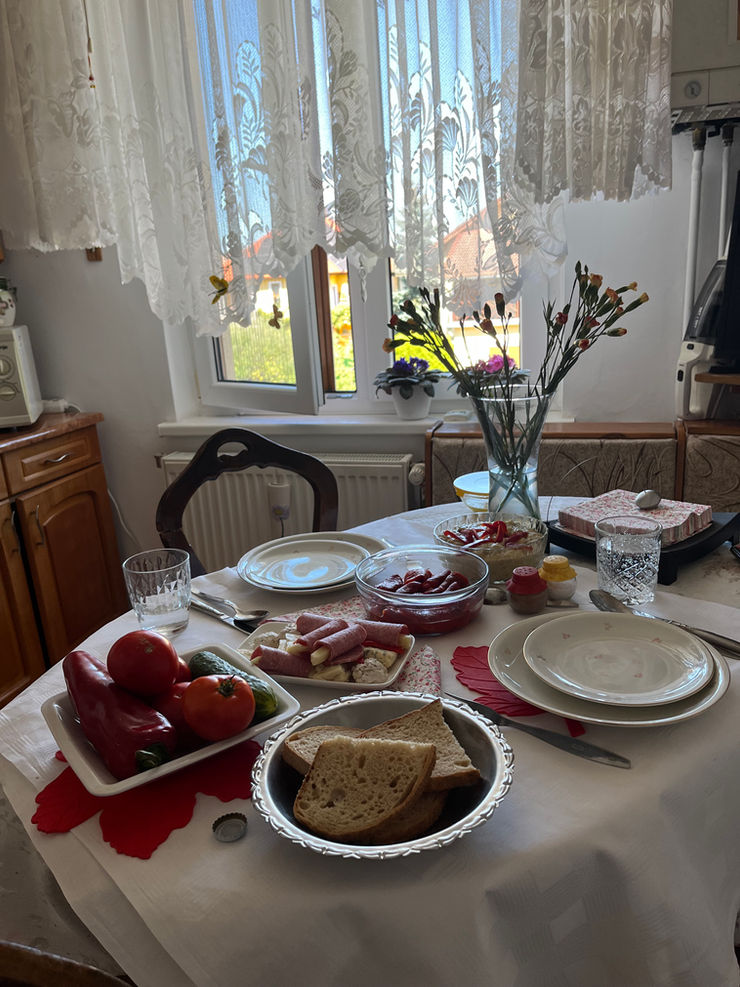
I have literally landed in Romania approximately 1 hour ago and am currently thoroughly enjoying the midafternoon light in my mother’s home in Sibiu, Transylvania. Travels were uneventful, and I am including some pictures: one from my stop in Vienna and one of my mother’s kitchen.
I am thinking about you waking up and drinking your coffee as you are reading this.
Today, I would like to discuss the very shady origins of the word “provider” as it relates to healthcare, and also to get your feedback on the TED Talk that I never gave (I wrote this piece in 2022, and it’s been sitting in my notes ever since, lonely and not-interacted with. “She” would love to be read today, by you.)
I was listening the other day to a very good podcast that my sister recommended, and I was surprised by the reaction I had when the podcaster, a very well-informed, well-rounded woman, referred to doctors as “health care providers”.
Did you know that several of the nation’s largest and most powerful medical societies have officially voted to oppose and ban the word “provider” within their own organizations and publications?
Here are the organizations I have just mentioned: The American Medical Association (AMA), The American College of Physicians (ACP) and The American Academy of Family Physicians (AAFP).
Why, you might wonder, did these medical societies did take such drastic action and ban this word from their organizations’s vocabulary? Why, even yours truly, has such a visceral reaction to this seemingly innocuous word?
Well, to get us started, some medical commentaries and essays have argued that the term “provider” originated in the 1930s when the Nazi regime stripped Jewish physicians of the title Arzt (doctor) and redesignated them as Krankenbehandler, which was translated as “health care provider” to demean them. This seems to be a widespread etymological myth based on a disputed translation. Subsequent historical and etymological analyses—such as articles published in the Journal of General Internal Medicine—have shown that linking Krankenbehandler to the English word “provider” is a factually baseless and misleading translation. Behandler actually translates more closely to “practitioner,” “treater,” or “therapist”.
The true origins of “provider” seem to be the mid-1960’s legislation. The term “provider of services” formally entered the American medical lexicon with the passage of Title XIX of the Social Security Amendments (establishing Medicare and Medicaid) in 1965. The label was created as a bureaucratic and legal shorthand for institutions (like hospitals, extended care facilities, or home health agencies) and later clinicians who received third-party reimbursements for delivered services.
Here are some of the reasons why physicians dislike being referred to as “providers”: years of hard work are being devalued and unique professional identities are erased by grouping doctors, nurse practitioners and physician assistants into one massive bucket by calling everyone a “provider”.
Healthcare is treated like a factory and the word “provider” uses corporate language that treats medical care like a commercial transaction. I don’t think it is too much of a stretch to say that being a physician has reached “commodity status”, and it makes medical care look like a vending machine, versus a human being using expert judgement. It also turns patients into “consumers” or “customers” buying a product, rather than people seeking healing. Also, when referring to physicians as “providers” seems to be very confusing for patients- they end up often not knowing who is in charge of their medical care.
Please keep in mind that the term “healthcare provider” was created by bureaucrats (insurance companies and government agencies) to make paperwork easier. It has a dry, impersonal vibe, definitely not representative of helpful for the trust relationship that is absolutely necessary for healing.
Let me step off the soapbox when it comes to this nefarious term and go on to present to you the skeleton of what was going tot be my TedTalk in 2022. As always, I LOVE hearing your thoughts.
Why the solution to global warming is napping. Napping as a political act.
I love naps. (Almost as much as I love food!)
What is the first thing you think about when I tell you that?
That I must be lazy, lethargic and lackadaisical. That I must be passive, indolent and inert. Possibly very slow moving. Or that you need to carry a whip when you’re around me, to whip me into shape?
The common assumption about people who nap is that we are somehow weak and lazy creatures, who picked a losing ticket in the genetic lottery of life. People who achieved the developmental level of a three-year old. You can see this in action when you google the word “nap”: “The Wubbulous World of Dr. Seuss: The Cat in the Hat Takes a Nap”, “An Elephant and Piggie Book: I will take a nap”, “ Naptime: Toddle Tools” or “ How do Giraffes Take Naps”.
Naps clearly have a PR problem. Today, I want to help change that.
Maybe by now, you’re wondering: what do naps have to do with global warming? How are they related?
At the Nap Ministry in Atlanta’s NW side, Tricia Hersey, the founder of the Nap Ministry and a Nap Bishop recites the Nap Manifesto: “We believe that rest, and napping, provides a healing portal for us to imagine, to hope, to invent, to create, to heal, to rest, to resist”.
I am a physician, and over and over again, in my 25+ year long career, I’ve seen patients coming in for feeling tired. Fatigued, exhausted. And in spite of feeling this way all day long, when I write them prescriptions for rest and naps, I invariably hear from them that they CAN’T NAP. They just can’t. They are so much in “fight or flight” that they can’t rest. Their autonomous nervous system is in high alert all the time. They are like the gazelle who knows she is being watched by the lioness for her next meal. When you nap, you don’t eat food, you turn into food? Is this really the way we are living our lives? It is! Our nervous systems are in high alert. All the time. We need to make sure we produce.
We can’t be lazy, because that means we are not serving as a tool for the system. Our bodies, our time, in capitalism and patriarchy are tools that are used by the system for the system. For the extraction economy. We extract and exhaust the resources of the Earth and we extract and exhaust our own energy.
Imagine a beautiful Sunday afternoon (and I’m only saying Sunday, because if I replaced that day with pretty much any other day of the week, you would probably block me and won’t hear anything else I say). You are at home, in your bedroom, in your sanctuary, in your soft, warm bed. From your bed, you can see a sliver of the bright blue sky, and there’s sunlight filtering through your curtains. You can also see a gorgeous, tall tree. It is quiet. Everyone else in the house is either reading or playing quietly. You stare at the sky and you feel all your limbs melting into the sheets. If you’re paying attention, a sweet feeling of surrender to the bed has enveloped you by now and your eyelids are becoming very, very heavy. . You close your eyes, and feel like Hypnos (the Greek God of Sleep), the son of Nyx (Primordial Goddess and Personification of The Night) and the twin brother of Thanatos (The God of Death) is taking you far, far away, on his wings, to the dark, musty cave in the land of the Cimmerians, through which flow the waters of Lethe, the river of forgetfulness and oblivion.
Now who doesn’t like that? I can’t think of too many feelings that are sweeter than the one where you surrender to Hypnos. Who is so wrapped up into doing, that they have trouble being? The answer is simple: most of us.
My dear friend Kristin, a beautiful middle aged woman, mother of two daughters, president of her company, general of her household, a highly intelligent and accomplished woman, came to me for advice about her fatigue. I did my doctor thing, I asked her questions, I gave her the usual tracking devices I give to my patients, and what I found out astounded me. Kristen was barely getting any sleep and she was running the equivalent of 20km a day. When I gave her nap prescription, she said, in a clearly disappointed voice that “she can’t nap, she was never able to nap, and really, is this all there is?” Isn’t her thyroid that is at fault? Her best friend has the same exact symptoms as herself, and the thyroid medication helped her a lot. Was I sure that she didn’t need a pill? The answer I gave her was very unsatisfactory. Kristin feels empty, restless, exhausted. Her incessant running is truly a metaphor for her wanting to run away from her life.
Kendall, another brilliant physician, in her 40’s, whip smart, a rebel and a visionary, an entrepreneur and a mother, has not taken a nap since she was a toddler. Her tracking devices show that she also, moves at the speed of light all day long and doesn’t really sleep that much or that good. When she has a moment that is free of the demands of her job or her babies, she smokes, or she drinks or has to alter her consciousness one way or another. She hates being present in her body and her life, and the voice that tells her that she is not productive enough won’t stop unless she mutes it with various substances.
Let’s dive deep into the science of naps
Sleep experts have found that daytime naps can improve many things: increase alertness, boost creativity, improve perception, stamina, motor skills, enhance sex life, aid in weight loss, reduce the risk of heart attack, brighten your mood and boost memory.
In one study of 23,681 Greek men over six years, the participants who napped three times per week had a 37% lower risk of dying from heart disease.
Napping can help you live longer, stay more active and look younger. It recharges the brain resulting in greater alertness, improved memory retention and creative insight.
Airline pilots and air traffic controllers already have sleep breaks built into their work routines because when you’re sleepy, you are seven times more likely to make an error. Some of the worlds’ greatest disasters have been directly attributed to fatigue including Chernobyl, Exxon Valdez and the Challenger space shuttle disaster.
Effects on mental health include improved mood, decreased stress and greater psychological balance. Napping will increase your patience.
If you’re feeling frustrated, according to researchers at the University of Michigan, who published a study in the journal Personality and Individual Differences, you should probably take a nap.
Participants were asked to complete a particularly frustrating task — drawing geometric designs on a computer screen. Those who took an hour-long nap before the exercise were able to draw for 90 seconds, compared to a control group who watched a documentary instead of napping. They gave up after about 45 seconds.
Power naps increase memory by almost 20 per cent during the remainder of the day.
A study conducted by researchers in Germany found that taking an hourlong nap can dramatically improve our ability to remember information. For the study, participants were asked to remember specific words and pairs. Then, half the participants watched a movie while the other half napped. When asked about their memory of the words, the nap group performed five times as well as the movie watching group.
Just thinking about napping can lower your blood pressure!
While an actual nap is certainly beneficial, so is the time before you take one. One British study found that participants’ blood pressure dropped before they even fell asleep - just anticipating the nap they were about to take was enough.
Naps can improve creativity
If you haven’t been feeling too imaginative lately, it’s probably time to hit the hay. A study conducted by psychiatrist Sara Mednick out of the University of California, San Diego, found that people who take REM naps- the sleep state where you’re dreaming- were more creative when it came to problem solving than non-REM nappers.
In other words, we end up less inflamed, less toxic.
We are less likely to snap at our loved ones, or to make mistakes and end up full of shame and guilt. We are more joyous and imaginative.
As a doctor, I am equally sad and heartbroken when I see more and more people falling prey to our cultural conditioning of speed, extraction and the never ending quest for MORE.
As a mother, I am terrified of the world I- we- are leaving for our children. I lose sleep over the fact that our beloved home, this beautiful Earth has been scorched, extracted and it’s becoming a not-so-welcoming home for the next generation.
If you’re like me and you feel paralysed by the complexity and urgency for climate action and you feel anxious, afraid, confused… I have an answer for us! We need to take our power back. Kristin, Kendall and all my patients who can’t nap, even though you’re tired: please take your power back! Please rest and give yourself permission to delight in the creative power of your imagination, and know that only when you stop overusing your own energy, your body will heal and that is when the Earth will heal.
u’re tired: please take your power back! Please rest and give yourself permission to delight in the creative power of your imagination, and know that only when you stop overusing your own energy, your body will heal and that is when the Earth will heal.
Now, that is why, every time my daughters wonder why I am yet again napping and resting, my answer is always the same: please leave me alone, I am not just sitting around doing nothing, I am saving the world!
With love, (a tiny sprinkle of) rage, and reverence, Your disorganized, recovering people-pleaser, community-dreamer, hope-filled activist in the making, deep-sleeper, clean compliment giver and receiver, not-a-true-exhibitionist, 21-day resetter, recovering prostitute, courageous by practice, trusting by skill, always with my head in the clouds, but loving my feet on the ground, soul worker (!), inner voice listener, pleasure list maker, Aquarium sleepover organizer, beginner-level meditator, wabi-sabi contemplator, self-fascinated observer, giving-up-machismo supporter, hot soup-slurper, enthusiastic and tired traveler, death by Yellowjackets antidote and higher consciousness dreamer, aspiring human rights warrior, zielschmerz-stricken, nap lover,
Corina



Comments